

Ever spent weeks just trying to get different systems to talk to each other? HRIS, payroll platforms, and benefits tools all have unique APIs, formats, and quirks. Your engineers get stuck building and maintaining one-off integrations, operations scrambles to fix errors, and sales waits on complex setups before closing deals.
API integration solves this. It connects multiple systems through a single, consistent interface, letting data flow seamlessly, automating repetitive workflows, and giving you real-time visibility, without tying up your developers.
In fact, 43% of fully API-first organizations generate over 25% of total revenue through APIs, proving that smart integration can fuel growth. Whether it’s synchronizing employee records, updating payroll contributions, or reconciling benefits enrollments, API integration keeps your processes accurate, consistent, and on schedule.
In this guide, we’ll walk you through the top 10 benefits of API integration for businesses, the types of integrations you can implement, and how they actually work.
Key Highlights:
- API integration connects multiple systems to automate workflows, reduce errors, and provide real-time visibility across HR, payroll, and benefits platforms.
- Different integration types, point-to-point, hub-and-spoke, cloud-based (iPaaS), and unified APIs, offer flexibility based on business scale and complexity.
- Businesses benefit from seamless operations, accurate data, cost savings, enhanced collaboration, scalable growth, and faster decision-making through integrated systems.
- Modern API integrations enable real-time syncing, error handling, embedded automation, and adaptability to new technologies for efficient, customized workflows.
What is an API Integration?

Businesses today rely on multiple systems: HR platforms, payroll software, and benefits tools. Out of the box, these systems rarely communicate, creating manual work and errors. API integration connects them so data flows automatically, keeping operations aligned and teams focused on value-driven work.
Key aspects to consider:
- Data structure and consistency: Ensure systems can align on formats for employee records, payroll, and benefits.
- Real-time vs. batch updates: Decide how often changes should sync across systems.
- Scalability: Consider whether the integration can handle growing volumes of data and new systems.
- Workflow automation potential: Evaluate which processes can move automatically without manual intervention.
- Monitoring and error handling: Plan for visibility into failed updates or discrepancies.
API integration requires careful planning to ensure systems communicate effectively and workflows stay reliable.
In the next section, let’s explore how API integration delivers real value across everyday operations.
Also Read: API vs Integration: The Differences and Intersections
How Can API Integration Benefit Your Business?
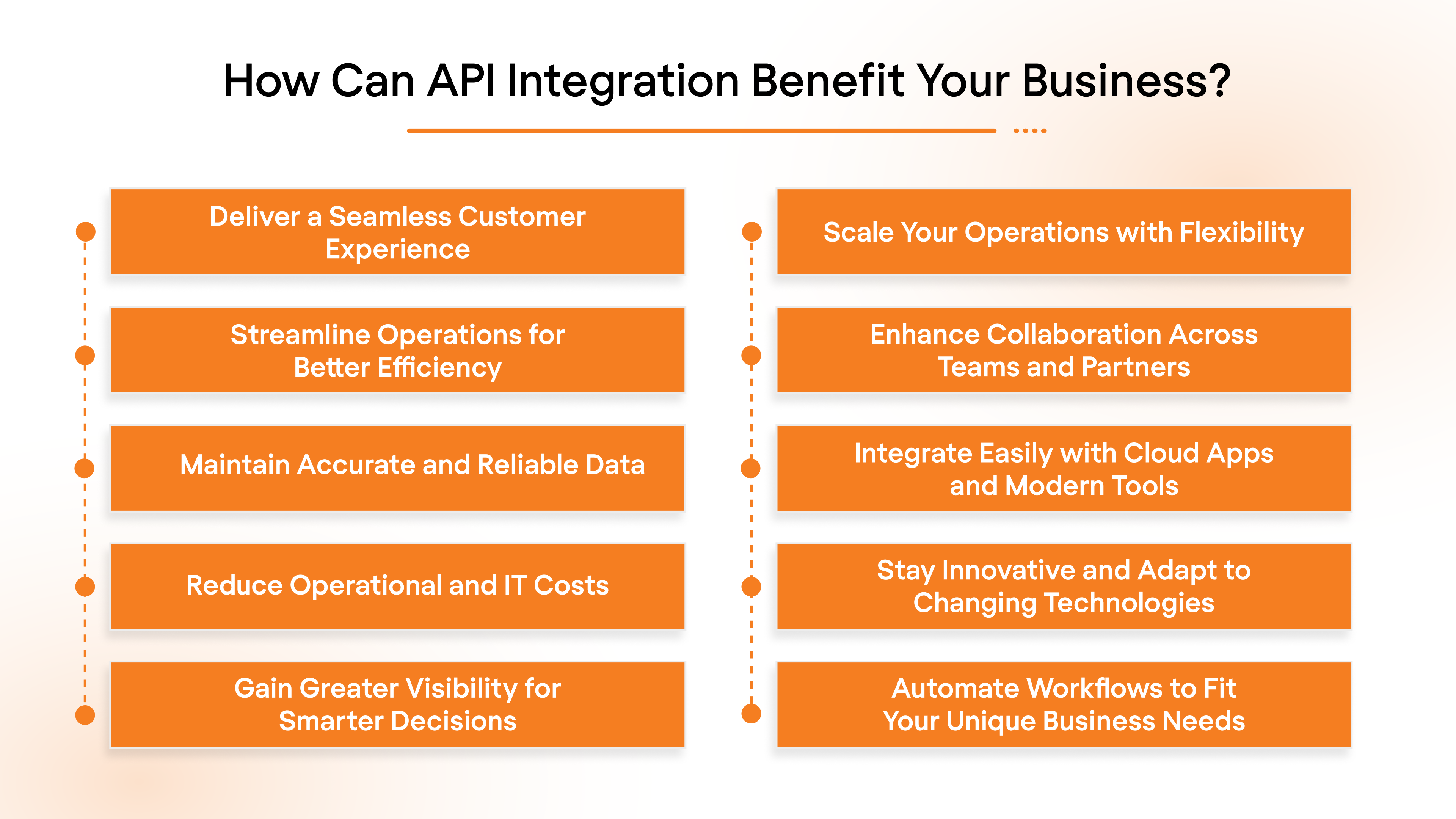
API integration offers measurable advantages that go beyond simple technical efficiency. Below, we’ll break down the key advantages in detail.
1. Deliver a Seamless Customer and Employee Experience
When your HR, payroll, and benefits systems talk to each other, employees and clients always see the most current information. No more discrepancies in PTO balances, deductions, or coverage details. This consistency builds trust and reduces frustration across teams.
A smooth, integrated experience also minimizes support tickets. When data flows automatically, employees and HR teams spend less time correcting errors and more time on meaningful work.
Example: An HR Tech platform automatically syncs PTO balances to payroll and benefits tools. Employees see their correct leave balances immediately, and payroll deductions are always accurate, eliminating hours of reconciliation work.
2. Streamline Operations and Reduce Friction
Manual updates and reconciliations slow teams down and create risk. API integration automates routine tasks, freeing your operations staff to focus on exceptions and strategic priorities.
Automation also ensures that data is consistent across platforms. When updates happen in real time, the chance of mistakes dropping into payroll or benefits processes is greatly reduced.
Example: Payroll deductions for multiple benefits plans are updated automatically. Operations no longer need to cross-check spreadsheets or emails, cutting errors and saving several hours each payroll cycle.
3. Reduce Risk and Ensure Compliance
In HR and benefits administration, even minor errors can have big consequences. Integrating systems ensures that employee records, contributions, and deductions are consistent, reducing compliance risks.
Reliable data flows also give your compliance teams confidence that audits and reporting requirements are accurate. You spend less time firefighting and more time on proactive oversight.
Example: When a new hire joins, their demographic information updates automatically across HRIS, payroll, and benefits platforms. This prevents mismatched records and ensures deductions and contributions are compliant from day one.
4. Scale Without Chaos
As your client base or platform grows, maintaining separate integrations for every vendor quickly becomes unmanageable. APIs let you scale efficiently without repeating the same development work.
This flexibility allows your product to onboard new HRIS, payroll, or benefits systems quickly, keeping rollout timelines short and predictable.
Example: Adding a new benefits provider integrates automatically with payroll and HR systems. What used to take weeks of engineering effort now happens in hours, keeping onboarding smooth and consistent.
5. Make Data Work for You
API integration centralizes and normalizes employee, payroll, and benefits data, making it actionable. You can generate insights faster and rely on accurate information for decision-making.
Real-time visibility helps teams spot issues early, optimize workflows, and identify trends that were previously hidden in disconnected systems.
Example: Operations managers receive alerts for failed payroll updates, product teams track PTO utilization trends, and finance reconciles payroll seamlessly, all without manual reports or spreadsheets.
6. Support Collaboration Across Teams and Partners
Integrated systems create a single source of truth for HR, payroll, benefits, and even external partners. Everyone has access to consistent, up-to-date information.
This reduces back-and-forth communication, prevents misaligned workflows, and allows teams to focus on strategic priorities rather than chasing data.
Example: HR, payroll, and benefits teams access the same real-time employee contribution data. External partners like retirement plan administrators see the same information, eliminating unnecessary emails and reconciliation.
7. Stay Flexible as Technology Evolves
Technology moves fast, and platforms need integration that can keep up. APIs make adopting new tools or features seamless, without breaking existing workflows.
This flexibility ensures your business can stay competitive, adopt AI or analytics tools, and continually improve employee and client experiences.
Example: Adding an AI-driven benefits recommendation engine is simple because employee and payroll data are already standardized across all systems. New tools plug in without disrupting current processes.
8. Customize Workflows to Fit Your Business
Every organization has unique operational processes. APIs let you tailor workflows and automate repetitive tasks while ensuring data accuracy and compliance.
Custom automation reduces human error, accelerates processes, and ensures that your operations reflect the way your business actually works, not the other way around.
Example: Automated approval workflows for benefits enrollments trigger notifications, update payroll, and sync with compliance systems, all without manual intervention from HR staff.
To fully appreciate these benefits, it helps to understand what’s happening behind the scenes. Let's discuss that next.
Suggested Read: 15 API Integration Platforms Every Business Should Know
How Does API Integration Actually Work?
Understanding the mechanics of API integration helps you appreciate the value it brings. Well-designed integrations handle data transfer, normalization, and error management automatically.
Here’s how it actually works:
1. Real-Time Data Exchange Across Connected Systems
API integration works by sending structured requests and receiving responses in real time. When an employee record is updated in your HRIS, the change is immediately sent to connected payroll or benefits systems, ensuring consistency without manual intervention.
2. Consistent Data Through Normalization
Different systems may store similar information in unique formats. Unified APIs normalize this data into a standard schema, so fields like employee status, pay groups, or dependent details are interpreted consistently across all platforms. This prevents misalignment and reconciliation errors.
3. Real-Time Syncs and Event Triggers for Instant Updates
Modern API integrations rely on event-driven updates and real-time syncs. When a relevant change occurs, like a new hire, termination, or benefits enrollment, the connected systems update automatically, minimizing latency and ensuring everyone sees accurate, current data.
4. Reliable Error Handling & Logging
Even the best integrations encounter errors. Effective API platforms provide automated error handling, logging, and alerting, so issues are detected and resolved quickly. This reduces operational disruptions and keeps support teams focused on strategic tasks instead of firefighting data errors.
5. Embedded Functionality and Automation for Streamlined Workflows
Many unified APIs allow embedding connection flows directly into your software via SDKs or magic-link authentication. Employees or clients can authorize connections themselves, while backend systems automatically handle synchronization. This level of automation accelerates onboarding and reduces manual oversight.
How Bindbee Can Simplify API Integration for Your Business?
Bindbee’s unified HR/payroll API is designed to remove the engineering and operational burden of building and maintaining multiple connectors.
Here’s how we can help you:
- Prebuilt Integrations Across 60+ Platforms: Gain instant connectivity to major HRIS, ATS, and payroll systems like Workday, ADP Workforce Now, Gusto, Rippling, BambooHR, and more. SFTP adaptors handle legacy file-based vendors, eliminating months of custom engineering work.
- Deep, Standardized Schema: Bindbee supports 16–17 unified models per integration, covering employees, payroll runs, compensation, time-off balances, dependents, pay groups, and other HR/benefits data. This ensures consistent, accurate information across all connected platforms.
- Real-Time Sync and Automation: Event-driven webhooks, automated retries, and self-healing processes keep employee and payroll data accurate and up-to-date, reducing operational risk and manual intervention.
- Operational Dashboards and Alerts: Visual dashboards provide visibility into logs, errors, and affected employees. Non-technical teams can quickly identify and resolve issues without relying on engineering resources.
- Embedded SDKs and Magic-Link Authentication: Seamlessly embed connection flows into your product, enabling employers to connect HR/payroll systems in minutes with a brandable, frictionless experience.
- Compliance and Security by Design: SOC 2 and ISO 27001 indicators, HIPAA support, GDPR-readiness, and standard legal artifacts (DPA, BAA, MSA) ensure your integrations meet U.S.-specific regulatory requirements.
- Faster Onboarding and Sales Enablement: Prebuilt mappings and operational tooling reduce employer setup from weeks to hours, helping your sales team close deals that require specific integrations without slowing down your product roadmap.
By utilizing Bindbee's unified API, businesses can streamline their integration processes, reduce operational overhead, and focus on delivering value to their customers.
Keep Your Systems Connected, Efficient, and Ready to Grow
Manual updates, disconnected systems, and error-prone workflows slow your operations and add hidden costs.
Bindbee solves this. With 60+ prebuilt HR, payroll, and benefits connectors, real-time syncing, and embedded automation, it takes the hassle out of integrations so your team can focus on product innovation, customer experience, and growth.
Book a demo today and launch your first API integration in under a week.
FAQs
1. What security advantages come with well-implemented API integrations?
Strong API integrations enhance security through strict authentication, authorization, and encryption. They reduce manual data handling, limit vulnerabilities, and ensure sensitive data moves securely between systems while staying compliant with industry standards.
2. How do APIs support real-time analytics and reporting?
APIs enable instant data sharing between systems, allowing access to live insights and automated dashboards. This real-time flow drives faster, more informed decisions without waiting for manual data updates.
3. What are the common challenges companies face when implementing API integration?
Key challenges include system incompatibility, inconsistent data formats, security risks, and integration complexity. Businesses may also struggle with high development costs, limited monitoring, and long-term maintenance.
4. How can businesses measure the ROI of API integration?
ROI can be measured through reduced operational costs, faster workflows, fewer manual errors, and improved customer satisfaction. Metrics like time-to-market, process automation, and increased revenue quantify integration success.
5. What future trends are shaping API integration in enterprise environments?
Emerging trends include AI-driven APIs, low-code integration tools, microservices, and stronger security frameworks. Enterprises are also shifting toward real-time, event-driven, and highly interoperable systems to boost agility and scalability.


